
by Zero Theory staff
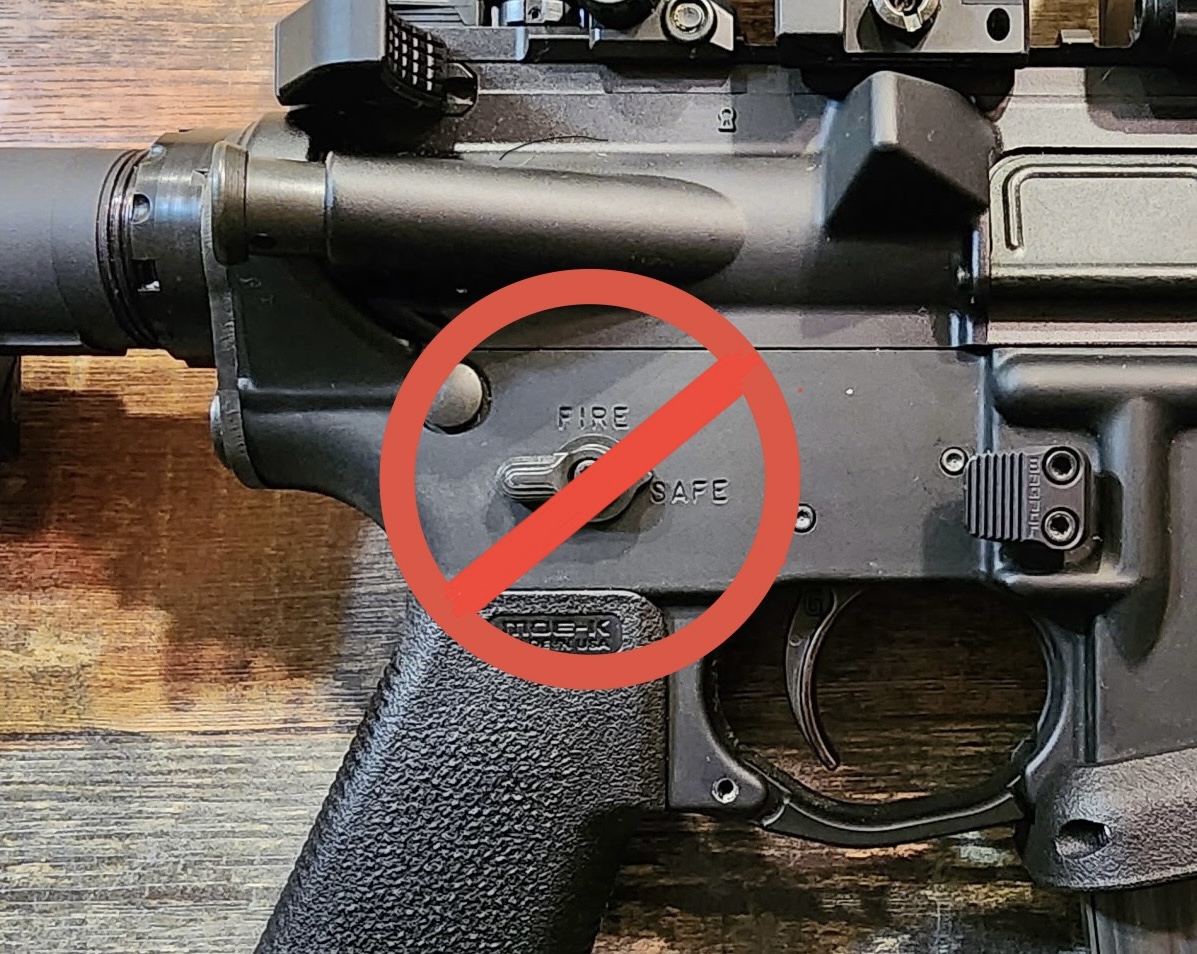
Ambidextrous safety selectors on AR-style rifles are very popular. They are sold as aftermarket upgrades and included on rifles from just about every high dollar manufacturer in the industry. They have been fully embraced by the shooting community as a premium rifle feature. Across the board, from manufacturers to end users, ambi safeties seem universally loved by just about everyone. Everyone, that is, except us.
We get it. Most people do not agree with us. We are in the minority on this issue. By taking this position we are challenging a norm. We are not exactly attacking a sacred cow, but we are definitely challenging some opinions; maybe hurting some feelings. Our objective is not mere obstinance. Hurting feelings is not our goal. Our goal is to tell the truth. And the truth is, ambi safeties are unnecessary, exist mainly for the benefit of manufacturers, provide minimal (if any) real advantage, and contribute to a potentially unsafe scenario.
Before we elaborate, let’s make one thing clear. We are not saying ambi safeties are necessarily unsafe in themselves. We know many people who use ambi safeties. We teach a lot of rifle classes. Our students are local/state/federal law enforcement officers, competition shooters, beginners, and experts alike. Most of our classes involve AR-style rifles and in almost every class people show up with ambi safeties. If they were necessarily unsafe we would not allow them in class. We don’t kick people out of class for having them, but we don’t sugarcoat it either. We don’t like them. The purpose of this article is to explain exactly why we don’t like them. So let’s go through each point individually:
Ambi safeties are unnecessary:
The primary use case we hear is right-handed shooters firing off the left shoulder. There are basically two techniques for this: the full transition and the shoulder bump. In both cases the shooter moves the rifle to their support shoulder. The full transition is when the shooter swaps the locations of their hands on the rifle so they operate the trigger and safety with their support hand while their strong hand grips the front handguard. The shoulder bump, by contrast, is where the shooter simply “bumps” the rifle over to the support shoulder and leaves their hands in the normal position. This position feels a little awkward at first but is very doable with a little practice. For the full transition, the shooter can manipulate a standard safety selector with the index finger or index finger knuckle of their support hand. It works just fine; we do it all the time. For the shoulder bump, the shooter’s hands remain in the normal position and the standard safety selector is operated as normal. In either case, the standard safety selector works fine, so the ambi selector is unnecessary.
Another use case we hear is left-handed shooters who ask for ambi safeties because they want to operate them in the same fashion as their right-handed brethren, that is, with the thumb of their strong hand. This is perfectly reasonable, but does not require an ambi safety. All they really need is a left-handed safety. It functions in a mirror image of the standard (right-handed) version described above and all the same scenarios apply. So here again, the ambi is unnecessary.
Right-handed or left-handed, strong side or support side, it doesn’t matter. A standard safety selector does the job and the ambi is unnecessary.
Ambi safeties exist mainly for the benefit of manufacturers:
If they are unnecessary, then why do they exist? As is so often the case, the answer is probably “money”. The job of a rifle manufacturer is to sell rifles. Premium rifles are made out of premium parts. Ambi safeties are marketed as premium parts and the industry has accepted them as such. Additionally, ambi safeties are a relatively low-cost/high-margin item. As an individual component, ambi safeties come in all types of configurations and can cost $50, $80, or more. Manufacturers know shooters are looking for the best gear to give them the best experience possible. They are not inherently evil, of course, but if you are willing to buy it, someone is willing to sell it to you whether it’s necessary or not. It’s an old story, buyer beware. Not everything you can buy for your rifle is an actual improvement, even if a multi-million dollar company tells you otherwise.
And let’s not place all the blame on the manufacturers. After all, they are only in business because we the consumers buy what they are selling. In other words, if we didn’t buy it, they wouldn’t make it. Buyers create demand and manufacturers produce the supply. So we as shooters carry some of the blame ourselves. At this point it is a sort of a chicken-and-egg situation. Regardless of how we got here, we are here now. So why do they exist? Bottom line…because people are willing to buy them. As long as they remain a profitable item, that will not change.
Ambi safeties provide minimal (if any) real advantage:
We can only think of two semi-plausible advantages to ambi safeties. The first is the shooter who has trained with an ambi safety and become accustomed to its use during support-side shooting. In this case, the shooter might legitimately claim a certain level of proficiency and comfort with it. Even so, this is an argument in favor of a preference, not an articulation of superior design or operation. The shooter developed both their skill and preference through training and practice. They could just as easily train and practice with a standard safety. As such, we do not consider familiarity alone a plausible advantage. We include it here only because we recognize some people legitimately develop expert-level skills with them and therefore argue in their favor. We submit this advantage is not substantive, which is why we qualify “minimal (if any) real advantage” above. All they are really saying is “I’m used to it” which is not a real advantage.
The second possible advantage is for injured shooter scenarios. Sustaining traumatic injury during a gunfight certainly can happen and may necessitate difficult and creative alternatives to the standard manual of arms (to say the least). In some instances, improvements in rifle component design may very likely improve an injured shooter’s ability to manipulate them. Oversized charging handles come to mind. That said, redesigning perfectly functional components should be approached cautiously and is probably best limited to situations where we can clearly articulate a specific benefit when weighed against the potential drawbacks. The benefit to an injured shooter is easy to imagine when we’re talking about increasing the purchase-area of a charging handle. Perhaps you could make a similar argument for an ambi safety, though the benefit is not nearly as obvious. Anecdotally, Zero Theory instructors have observed or conducted hundreds of injured shooter training scenarios. Not once has anyone commented afterwards “sure am glad I had that ambi safety”. So here again, the benefit is minimal, if any.
We are not saying there are absolutely zero benefits to ambi safeties. There may be benefits we have not considered. We are saying, however, whatever benefits exist must be weighed against the potential downsides and there is at least one, and it’s a big one…
Ambi safeties contribute to a potentially unsafe scenario:
In Zero Theory classes we teach our students to maintain positive control of their rifles as often as practicable, but we recognize there are times when you may need to place your rifle on safe and let it hang across your chest while you are busy with something else. You may need to put your hands on someone, lift something, whatever. Things happen. In a situation where you need to release your rifle with both hands we advocate rotating the rifle so that the safety selector is facing outboard of your body. This mitigates a potentially unsafe scenario which many people never even consider. We all have clothing on our bodies between us and the rifle: shirts, jackets, belt buckles, etc. As tactical shooters, we often have even more: magazines, tourniquets, and other gear. With a traditional two-point sling when we release positive control with both hands the rifle will naturally lay with the safety selector against our body and all that gear. When this happens it is possible, and not uncommon, that the safety selector is unintentionally moved to the “fire” position without notice. Once this happens we have a loaded rifle, off safe, hanging around our chest and pointed at our feet. When you are moving around enough to unintentionally disengage the safety you are also in danger of catching the trigger on your gear and unintentionally cracking off a round. Sounds far fetched? Too many “ifs” in a row? We agree…except that it happens, and probably more than you think. Not only have we personally seen safety selectors unintentionally disengaged in this manner on multiple occasions, but we are also aware of a negligent discharge incident where this exact situation occurred within one of our own agencies. In this particular case the shooter was hopping onto a truck tailgate. The safety had been disengaged and the trigger caught his gear just right. BANG! BANG! Two rounds fired right towards his feet. Apparently the recoil from the first round bounced the rifle just enough to reset the trigger and allow the second round to fire. While this particular incident was from within one of our own agencies, we’ve heard stories from other agencies as well. It’s not some Safety Sally issue. It happens in real life.
To be clear, this situation occurs when the safety selector is facing the shooter’s body whether it is ambi or not. If you face a standard selector towards your body and release positive control of your rifle, you’ve created a potentially unsafe situation. This is why at Zero Theory we advocate rotating your rifle outboard when hanging it across your body on a sling. (As a side note, this also creates a tighter fit to your body – especially when you wedge the magazine beneath the sling). With an ambi safety, however, this is not possible. No matter which side of your rifle is outboard, there is still a selector lever resting against your body.
For left-handed shooters, everything works the same way, just in a mirrored fashion. With a standard left-handed safety (selector on the right side, no selector on the left side) just flip your rifle outboard and you’re good to go. Here again, a standard safety selector (left-handed) works as designed and mitigates an unsafe situation, but an ambi safety does not.
Again, we are not saying ambi safeties themselves are inherently unsafe. But they do contribute to the potentially unsafe situation described above. When people use ambi safeties in our classes we call attention to the situation and make it clear it is their responsibility to prevent creating an unsafe situation. They can do this by keeping both hands on the rifle at all times, setting it down when they need their hands free, or simply unloading it. In other words, they have to avoid slinging a loaded rifle. This is a hassle and mostly negates the purpose of the sling. The preferable solution is to use the sling as designed and without creating an unsafe situation by rotating the rifle outboard – a solution which only works with a standard safety.
Conclusion
So there we have it. Ambidextrous safety selectors are unnecessary, exist mainly for the benefit of manufacturers, provide minimal (if any) real advantage, and contribute to a potentially unsafe scenario. This is not a popular opinion, we understand. People love their ambi safeties. But that doesn’t mean we’re wrong. Zero Theory is a small operation to be sure, but in the decades of experience we collectively possess arresting people at gunpoint and fighting in combat not one of us has ever come away from a tense situation saying “…if only I had an ambi safety”. We don’t put ambi safeties on our guns and if we buy a gun with one already installed, we remove it. We recommend you do the same.