
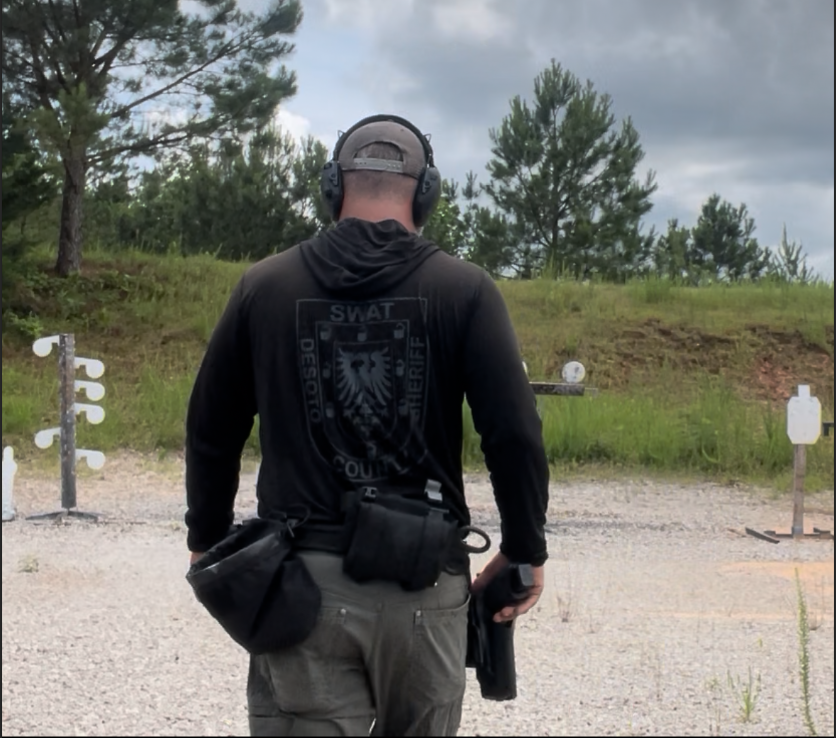
Optimizing Training Time
by Randy Davis
In this article I wanted to share some concepts I use when developing and organizing training for classes and my individual training. Much of the training I received early in my career was ineffective because it lacked an understanding of core principles and instead relied on the mindset of “the way we have always done it.” While some of the things presented were good, the depth of knowledge was missing. This prevented me from getting the full value of the training. Hopefully this will help when organizing your personal training.
Training vs Practice
To steal a phrase from Joe Rhoades of Redbeard Shooting Solutions, “words have meanings.” For the purpose of this article I will define training as the presentation and implementation of new ideas and concepts. Practice is the repetition and hopefully mastery of the ideas and concepts received in training. Why is this important? If you attend a class and never practice the things covered in the class, you have wasted your time going to the class.
Most of us have finite resources to spend on training. It is important to spend the time mastering the things presented to get the most out of the training you received. This is where a dry fire training plan really shines. You will be amazed at the progress you can make with just five minutes of dry fire a few times a week, provided those sessions are done with full focus and a deliberate plan. A Mantis system is a really good dry fire tool to keep you on track and provide a level of accountability.
Drills
Drills should have a point beyond looking cool on YouTube. As a shooter, you should evaluate each drill to determine which fundamental or fundamentals it is designed to develop. Doing so allows you to focus your training on specific deficiencies you’ve identified. Trying new drills is enjoyable, and the end of a training day is a great time to experiment with something you’ve seen, but always take a moment to identify what the drill is actually training. Some drills emphasize shooting fundamentals, while others focus primarily on weapon or equipment manipulation. There is overlap between the two, but most drills have a clear primary purpose.
A good example of this would be a Check Drill vs a Bill Drill. The Check Drill addresses presenting the rifle, pistol transition, holstering the pistol, a weapons check, reload, and additional rifle presentation. A Bill Drill primarily checks grip stability and trigger manipulation at speed. Both types are necessary to become a proficient shooter but viewing drills in an analytical manner will greatly enhance the speed of proficiency.
Look for a mix of drills that address multiple tasks and others that isolate a single task. Multi-task drills often reveal specific failure points, which you can then address with more focused, single-task drills. For example, the Baer Solutions “Standards” drill works target presentation, rapid multiple shots, target transitions, reloading, and throttle control to make precise hits on a smaller target. Also remember that at a certain point, repeated exposure to the same drill only makes you better at the drill itself, not at the underlying fundamentals it is meant to develop.
Performance vs Outcome
Borrowing a principle from Pat McNamara, the concept of performance- versus outcome-based training helps clarify how training should be organized. Outcome-based training focuses on meeting predetermined standards. This has value and is necessary to a degree, but it should not be the primary focus of training. In my view, outcome-based work should make up roughly 20 percent of training, serving to validate the other 80 percent, which should be performance-based. Performance-based training focuses solely on improving execution, with no predefined standards, emphasizing repetition and correct performance of the task itself.
Speed is built through repetition and maximizing economy of motion. Unfortunately, much of modern training emphasizes the opposite, with outcome-based training making up the majority of the focus. Law enforcement training is a clear example, where an overemphasis on qualification courses often detracts from developing true shooter proficiency. Qualifications and drill standards are necessary, but they should not be the primary focus of training.
What Am I Training to Do?
Determining the primary purpose of your training helps refine your focus. For example, if training for a competition I focus on predictive shooting, reducing split times, and movement efficiency. For tactically-focused shooting, I focus on reactive shooting, cover utilization, and movement efficiency.
There is a lot of value in competition shooting for tactical shooters. I like to incorporate aspects of the competition world into my tactical training. Weaknesses are exposed in competition which cannot be replicated without the stimulus of pressure. The failure point for tactical shooters is solely focusing on the competition aspects without maintaining the tactical principals. If you are shooting a competition with the goal of winning, fully commit to a competition mindset. If you are using competition for training value, remember the purpose of the training and understand that adhering to tactical principles will cost you time.
Stages are a great way to identify deficiencies in your skills. Using a stage to identify issues and using focused drills to address the problem is an efficient way to enhance performance. Doing only one or the other greatly limits growth as a shooter. This requires analytical thinking, if you set up a stage for yourself also determine which subtasks are involved in the stage. Identify drills that address the subtasks and use them in a progressive manner to work the necessary skills. After completing the subtask drills, then use the stage as a test to verify improvement. Compare apples to apples: if you shoot a stage warmed up, repeat it warmed up; if you shoot it cold, repeat it cold on a different training day. This helps prevent skewed data.
Comfort Zone
A common phrase in Jiu-Jitsu is “be comfortable being uncomfortable,” and it is key to progress. Nothing grows in a comfort zone. Push yourself by doing things outside your normal training, without outrunning your headlights or becoming an unsafe shooter. For example, work your support side, vary your drills, or, if you normally focus on speed, shoot bullseye targets at 25 yards for score. Stepping outside your comfort zone exposes gaps in your skill set and strengthens the areas you already do well.
Conclusion
Doing anything well requires dedication and analytical thought. Shooting is no different. If you are doing something, think about the why. This will help optimize your training and view the concepts presented in training classes with a greater depth of knowledge. If your progress has stagnated I hope this will help you move to the next level.
About the author: Randy Davis is a sniper instructor and sniper team leader on a law enforcement SWAT team. He previously served in various tactical and precision shooting roles in both the US Army and as a private contractor. Some of his hair is gray, but he’s mostly earned it.
Like this? Check out our other articles…
[025] Optimizing Training Time
Optimizing Training Time by Randy Davis In [...]
[024] Who We Are – What We Say Yes To
by Zero Theory staff What We Say Yes To “The [...]
[023] Who We Are – What We Say No To
by Zero Theory staff What We Say No To Performance [...]