
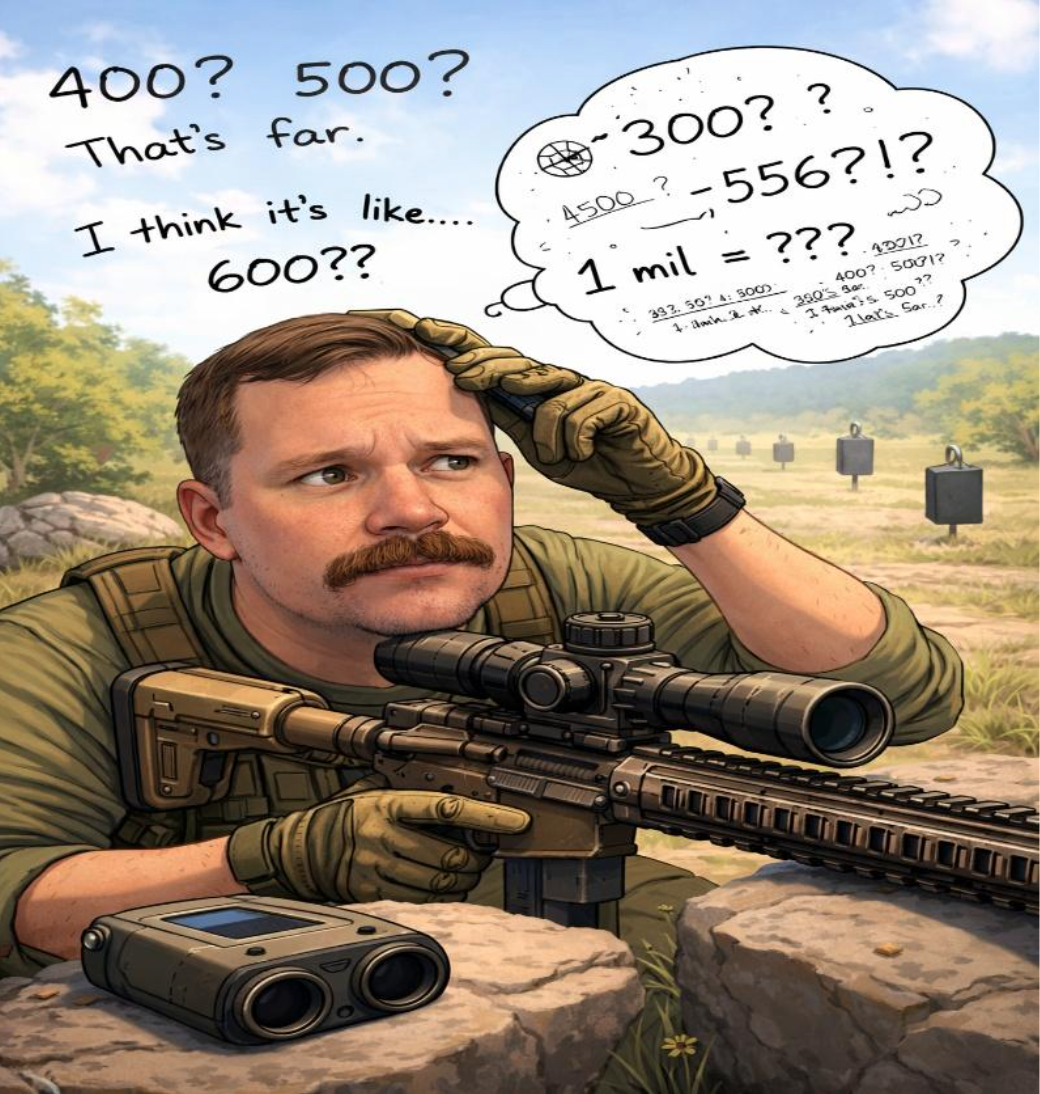
Measure Twice? Nah – Just Send It
by Zach Stamp
I’m back, baby! After a two-year hiatus, I am finally back! And to celebrate, I am introducing a series of articles on unknown distances and rapid engagements. In this series, I am going to start by discussing the fundamentals of unknown distances and rapid engagement, then move on to choosing the right rangefinder for the job, and end with how to properly zero and use a weapon-mounted rangefinder. Let’s get started.
What do I mean by “unknown distance”? It is simply a target whose distance I do not know. Simple, right? I must first determine the distance to the target to apply the correct dope and make the hit. In the military, I was taught to use the Mil Relation Formula. Essentially, I am taking a known-size target (let’s say a 30-inch IPSC target), multiplying it by 27.7 for yards, and dividing it by the size in mils as measured through my scope. This method works well when targets are uniform in size, their dimensions are known, and they remain still long enough to obtain an accurate measurement. We would send an instructor downrange to begin removing targets once the range was cold and shooting had concluded. We would have our students measure the instructor to determine a distance, and very rarely will they come up with an accurate one. Inside 500 to 600 yards, with a sufficiently large target, this is manageable; however, as distances approach the transonic range, even minor measurement errors result in significant ranging inaccuracies. This has long been how the Army taught and tested students on unknown-target engagements—until recently. The Army has now stepped into the 21st century and begun allowing students to use a device called a Laser Rangefinder (LRF). What’s the best way to engage a target at an unknown distance? Make it known. LRFs are among the most effective tools for obtaining fast, accurate distance measurements. I’ll cover them in greater detail in a future article, so I will keep this section brief.
Another method I frequently use involves reference points, known in the Army as Target Reference Points (TRPs). This method uses known distances to points in the surrounding area to estimate the distance to the target. For example, I know the distance to the edge of a food plot is 350 yards, and I have a target roughly 25 yards past that point. Based on that, I can put 375-yard data on my rifle and hit the target. I have used this method extensively while hunting. We would range fixed points around our hut and write those distances on the wall, giving us a quick, rough range to any deer that entered the field. I was able to use this technique very effectively during the Legion Sniper Competition in 2023. The match was hosted at Fort Campbell on a range I have spent many, MANY hours on. I knew that range well enough that I could see where the target was placed and instantly determine the range accurately enough to get hits on steel. This allowed my partner and me to engage targets quickly without spending additional time ranging them. The downside to this method is that it only works in familiar environments. You must already know the distances to fixed locations to use this technique. Also, do not use reference points that can move. It does no good to reference a known point that is no longer there.
The methods discussed above are effective and can be used at nearly any distance. However, if the target is relatively close, sufficiently large, and precision is less critical, speed becomes the priority. This is where Rapid Engagement Techniques (RET) come into play. There are many methods for this—some effective, others less so (cough 12in drill cough). These techniques are generally effective out to approximately 600 yards and typically carry an error of about 1 MOA (approximately 0.2 mils). While these techniques won’t win PRS matches, they are highly effective for quickly engaging targets.
First, we will discuss how to obtain a rough estimate of distance. I typically use the judging-by-eye method to estimate distance. There are a couple of good ways to do this: the 100-yard (football field) method, the appearance-of-object method, or my favorite, bracketing. The 100-yard method is to look at the target and estimate how many football fields would fit between me and the target. Appearance-of-object is where you look at something you are familiar with, such as a vehicle or a person, and judge the distance based on how clear you can see details and the size of the object. And my favorite technique is bracketing: I look at the target and determine, for example, that it is farther than 400 yards but under 600 yards, so I will use 500-yard data and see where that lines up on the target. If you practice these techniques, it is surprising how accurate you can become. Judging distance by eye does have some downfalls. Different terrain, vantage points, and many other factors affect your accuracy. It is wild how many things out there like to play tricks on your eyes. Looking down narrow city blocks makes everything seem much farther away than looking across an open field. This method takes a LOT of practice to perfect, so anytime you are on the range, take a moment to guess ranges before you ever pull out the LRF and see how you do.
Now that we have an estimated range to our target, we need to quickly get a hold over and send it! One useful technique I bet everyone shooting ARs nowadays uses and may not even know it is Point Blank Zero (PBZ). Many times you will hear people describe the battle zero on an AR, using a near-zero (25m, 50yds, 36yds) that will give them a far zero that allows them to hold center and get a hit on a full-size IPSC out to around 350 yards. This same method can also be used on your precision rifle. When I was operating in cities in the Middle East, I would set a 200-meter zero on my 5.56 MK12 to hold center on any target that presented itself, and I could get good hits at any realistic distance I would encounter. One of the instructors I used to work with would pull overwatch with his closest target 500 meters out. In this case, he would simply dial 500-meter dope on the scope. Many ballistic solvers nowadays have a feature inside them where you can input the size of your target, so for example, my target is a 20” circle. I go into the MaxPBR feature of my Kestrel and plug in 20 in the target size and the Kestrel will give me an elevation hold that will keep me inside that 20” bubble. It will also give me the max distance that hold will allow before it falls under the 20” target. This method works great because out to my Max PBZ range, I don’t have to think. I just aim in the center and pull the trigger. Past that, I hold over the target. [Editor’s Note: for more on this topic, check out [004] Maximum Point Blank Range]
A newer technique that has recently gained a lot of traction with weapon-mounted rangefinders (WMLRF) is Speed Drop. Speed Drop can be very fast and pretty cool. Todd and Kobe Hodnett of Accuracy First created this method. If you go to the Accuracy First feature inside a Kestrel, you will find the Speed Drop portion. It will provide you a negative elevation to dial on your scope (negative, meaning you are dialing down past your zero) and the minimum and maximum distances this method will work. It will also give you the option to choose between 0.1- and 0.2-mil errors. This means you are willing to have a built-in error of 0.1 mils or 0.2 mils in your hold-over data. So once you dial down the required elevation, typically in the 1.7-mil area, you have to range the target and divide that by 100; that is your holdover. Or, more simply put, if the target is 540 yards away, I hold over 5.4 mils and will be within 0.2 mils of the true data. Now, the downside to this technique: you need a way to range the targets, which is why this technique was created around the widespread use of WMLRF. Without that, you can’t really use this method. Also, most modern scopes have a built-in zero stop that only allows you to dial 0.5 mils below your zero. So, to use this method in the textbook way, you have to start doing some unconventional turret adjustments to dial down the required 1.7 mils.
OH NO!! I just bought this expensive WMLRF, and I want to use Speed Drop to justify my purchase, but my scope can’t dial past -0.5 mils! What do I do?!? Lucky for you, we have a solution. We combine PBZ with Speed Drop and get the benefit of both. Let’s say my Speed Drop number is 1.7 mils. In that case, I dial up 1.3 mils instead. This gives me roughly a 350-yard zero with most standard .308 Winchester or .223 Remington ammo. I hold center on every target until I start to see myself hitting low. From there, I start using my WMLRF and use the distance for my holdover just like I would for Speed Drop, but now I subtract 3 mils (1.7 + 1.3 = 3.0) from the holdover. Going back to my 540-yard target, my hold would become 5.4 − 3.0 = 2.4 mils. Many Special Operations snipers are starting to use this combination technique overseas. It is a great technique when speed is more important than exact precision. Just remember, everything is a trade-off.
In conclusion, while there are a million ways to skin a cat, these are not the end-all, be-all for unknown distances or rapid engagement techniques. These are just a few that work for me. Join us at one of the Zero Theory DMR Unknown Distance & Mover classes to practice these techniques. These are the skills that separate the generic PRS shooter from the superior sniper competitor.
About the author: Zach Stamp teaches sniper and scoped rifle courses for Zero Theory. He is a federal agent, competitive precision rifle shooter, former Special Forces sniper and sniper instructor. He is also a snappy dresser with a flare for standout colors in a sea of earth tones. Among the ZT instructors, his is the most glorious mustache.
Like this? Check out our other articles…
[025] Optimizing Training Time
Optimizing Training Time by Randy Davis In [...]
[024] Who We Are – What We Say Yes To
by Zero Theory staff What We Say Yes To “The [...]
[023] Who We Are – What We Say No To
by Zero Theory staff What We Say No To Performance [...]