
by Zero Theory staff
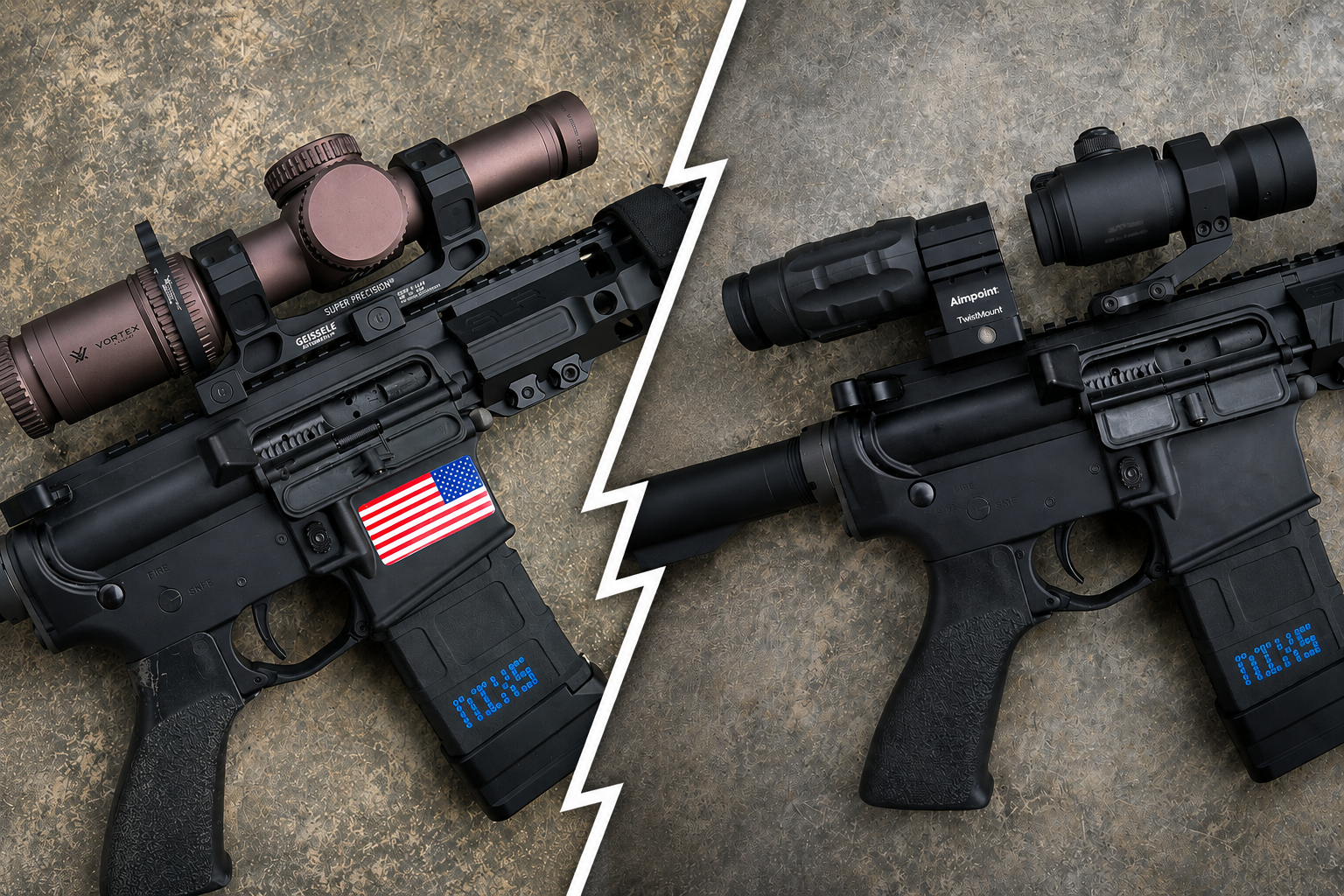
People often ask whether they should choose an LPVO or a red dot paired with a magnifier, as if the two systems were simply different versions of the same idea. The internet is full of videos, forum posts, and debates comparing one against the other. It is a question we hear regularly in our LPVO classes: “Why not just run a magnifier behind a red dot instead?” The problem is this comparison begins from a flawed assumption. An LPVO and a red dot + magnifier are not competing versions of the same system. They are fundamentally different tools designed around different priorities and different applications.
That reality also makes the title of the article somewhat misleading because it suggests a direct apples-to-apples choice when this is actually more of an apples-to-oranges comparison. In our LPVO training classes we teach a dedicated “comparison to alternatives” block where we discuss this exact topic in detail. We cover the pros and cons of each system, the ideal use cases, and the technical differences that separate them. Once you understand the inherent differences in design, the application part is pretty easy. The question begins to answer itself.
LPVOs and red dot + magnifier combos are different tools built for different purposes. They overlap in capability to some degree, but are not interchangeable. Comparing them as though one is simply a “better” version of the other is a comparison based on a false premise. They are fundamentally different from each other. While they are both essentially close range optics with added capabilities at distance, each system was designed around a different set of priorities. Understanding those differences is the key to choosing correctly.
The Red Dot + Magnifier Concept
A red dot sight is optimized for speed at close range. It is fast, simple, forgiving, and easy to use from awkward positions. There is no eye relief to worry about, no eye box, and very little penalty for poor head position. At close range, especially inside typical home-defense or urban distances, a red dot is extremely difficult to beat. Adding a magnifier gives the shooter some additional capability at longer distances. The magnifier can usually be flipped into place when needed and moved out of the way when it is not. For a shooter whose rifle is used almost entirely at close range, but who occasionally wants more precision or more ability to identify a target at distance, this setup makes a great deal of sense.
The important point, however, is that the magnifier is an accessory to the red dot, not a replacement for a true magnified optic. The biggest reason is physical construction. Magnifiers are typically very small. A common example is the Vortex Micro 3X. It is compact and lightweight, which is part of its appeal. But magnification through a tube and a series of lenses is still subject to the laws of physics. The smaller and shorter the optic body is, the less forgiving the eye box becomes. That is why magnifiers usually require the shooter to get very close to the optic. Most have very short eye relief and a narrow window through which the image can be seen clearly. The result is that, once the magnifier is flipped into place, the rifle often becomes noticeably less forgiving. The shooter has to mount the gun more consistently and place the eye in a smaller, more exact position behind the optic. This is actually true of all magnified prism optics. For example, the venerable ACOG is notorious for short eye-relief.
An LPVO is different. Because the optic is physically larger, with a longer tube and larger lenses, it can provide a larger exit pupil and a much more forgiving eye box. The shooter does not have to be in exactly the same position every time in order to see a full, clear image. This matters more than many people realize. In unconventional positions, around barricades, or while moving, the more forgiving eye box of an LPVO makes the rifle easier to use.
LPVO Reticle Capability
Another major difference is the reticle. A magnifier does not add any additional information to the red dot. The shooter still has the same single aiming point. It is simply larger. An LPVO, on the other hand, has an etched reticle. That reticle may include holds for distance, wind, moving targets, or more. It may provide ranging information. It may allow the shooter to make rapid corrections without touching the turrets. Most LPVOs also include illumination, allowing the center of the reticle to function much like a red dot at close range while still preserving the advantages of the full reticle when magnified. At distance, that becomes a significant advantage. A red dot with a magnifier can help the shooter see the target better. An LPVO can help the shooter both see the target and make a more precise shot.
Many shooters think of magnification only in terms of hitting the target. In reality, magnification is often more valuable for seeing and understanding the target than for shooting it. An LPVO excels at observation and target identification. At intermediate and longer distances, the shooter may need to determine whether a target is armed, what exactly the target is doing, whether a partially exposed target is actually visible, or even whether the object being observed is a target at all. A magnifier can help with that to some extent, but because of its smaller field of view and more restrictive eye box, it is usually less comfortable and less effective for prolonged observation. Magnifiers also often have lower quality glass than LPVOs of similar pedigree. For all these reasons, the LPVO is much better suited to spending time behind the glass.
The Value of Intermediate Magnification
One of the most common misconceptions about LPVOs is that people only ever use them at one power or maximum power. According to this idea, a 1-6 LPVO is supposedly used only at 1x or at 6x, which leads some people to argue a red dot plus a magnifier provides almost the same capability. People who actually use LPVOs know this is not true. The intermediate magnification settings are often some of the most useful.
On a 1-6 LPVO, 2x, 3x, 4x, and 5x are all valuable in different circumstances. A shooter may use 2x or 3x when moving through a wooded area, 4x for identifying and engaging targets at moderate distance, and 5x or 6x for a more precise shot or more careful observation. That ability to select exactly the amount of magnification needed is one of the greatest strengths of the LPVO.
A magnifier does not provide that flexibility. It is either in place or it is not. The shooter is effectively limited to two choices: unmagnified or whatever magnification the magnifier provides.
Where the Red Dot + Magnifier Still Wins
None of this means that the red dot plus magnifier is a bad setup. In fact, there are situations where it is clearly the better choice. If the rifle is used almost entirely at close range, especially inside one hundred yards, the red dot is generally faster and simpler. The rifle can be shot from unusual positions with less concern about eye alignment. The optic is often lighter and more compact. The shooter can immediately transition between unmagnified and magnified use simply by flipping the magnifier out of the way. For a rifle used primarily for home defense, close-range patrol work, or situations where magnification is only an occasional requirement, the red dot plus magnifier can be an excellent option.
Where the LPVO Wins
The LPVO becomes the better choice when the rifle is expected to do more than simply make hits at close range. If the shooter may want to identify targets, observe for extended periods, make precise shots, engage at varying distances, or take advantage of holds in the reticle, the LPVO offers capabilities that the red dot plus magnifier simply cannot match. For a general-purpose rifle, a rural patrol rifle, a competition gun expected to engage from near to far, or a rifle intended for uncertain conditions, the LPVO is usually the more capable and more versatile tool.
Conclusion
The question is not which system is “better.” The question is: what problem are you trying to solve? A red dot plus magnifier is a close-range system that can be stretched farther when necessary. In one sense, an LPVO is the same, but its larger tube size, etched reticle, and variable-power features give it capabilities that simply cannot be matched with a simple magnified red dot. If your rifle is almost exclusively a short-range gun and you occasionally need a little more reach, a red dot with a magnifier may be exactly the right answer. If your rifle needs to perform across a broad range of distances and conditions, the LPVO is usually the more complete solution.
No matter what you choose, always remember the mission drives the gear, not vice versa.