

by Zero Theory staff
The Optic I Didn’t Recognize
I first became aware of the Alpha TARAC by TACOM HQ at SHOT Show in 2024. While at an industry range day, I noticed a rifle wearing what appeared to be a magnifier. Only it wasn’t mounted where a magnifier normally belongs. Rather than sitting behind the optic, it was mounted in front of it, like a clip-on night vision or thermal device. For someone who spends a lot of time around rifles and optics, it was unusual to encounter a completely unfamiliar product category. I didn’t know what it was.
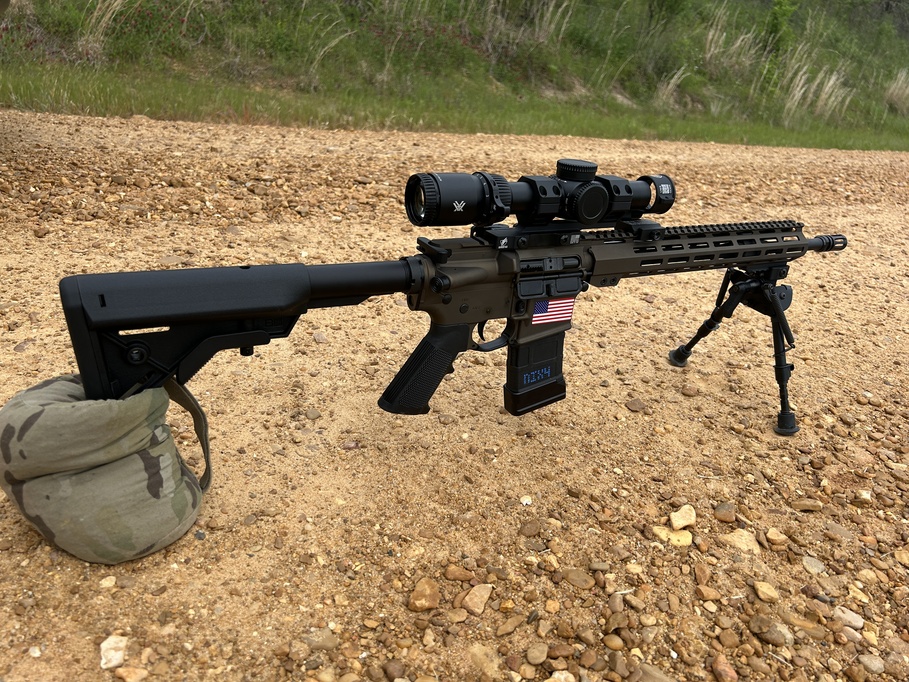
The guy behind the rifle explained it was an Alpha TARAC and described how he used it on his 14.5” 6 ARC for hunting. His explanation was simple: inside roughly 300 yards he held directly on the target. Beyond that distance he flipped the TARAC into place and continued holding directly on the target.
The concept immediately caught my attention because it addressed a topic we discuss frequently in Zero Theory classes and articles: maximum point-blank range (MPBR) shooting. The initial question was simple: Does this thing actually work? But the more interesting question turned out to be: Who is it actually for?
Understanding the Alpha TARAC – What is it?
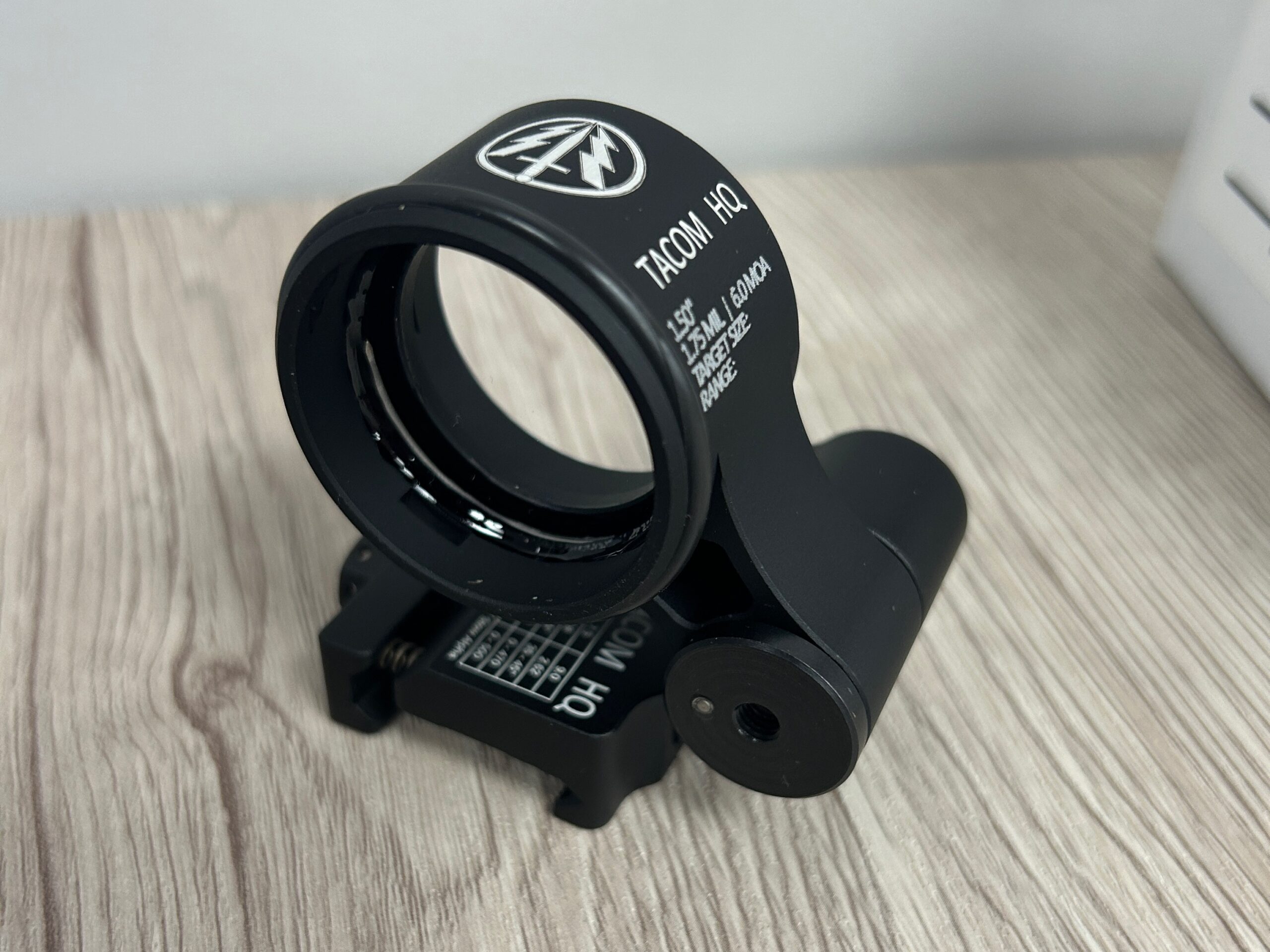
The Alpha TARAC is a flip-to-side optical device that mounts in front of an existing optic. It does not contain a reticle. It does not contain electronics. It does not provide magnification. Instead, it imparts a fixed angular shift to the optical image. Looking through it is like looking through a window: you don’t even see it. No reticle, nothing. The shooter believes he is aiming normally, but the rifle is actually pointed slightly differently than it would be otherwise. The practical result is a predictable shift in point of impact. The models we tested provided fixed offsets of approximately 1.75 mils and 2.18 mils.
One of the most surprising aspects of the Alpha TARAC is when you look through the optic, almost nothing appears to change. There is no magnification increase. There is no reticle change. There is no ballistic data. There is no visible aiming reference added. You simply look through your optic and continue aiming normally. The difference is the Alpha TARAC is causing you to unknowingly aim slightly higher. This affects the trajectory of the round and effectively extends MPBR, among other possible applications.
What It Is Not
The guy at SHOT Show went so far as to say “I don’t even hold DOPE anymore.” This was certainly an embellishment, but his point was worth considering. He was saying that given an acceptable target size, this device can extend the distance at which you can engage a target by simply holding dead on. This may be true, but the distinction is important. The Alpha TARAC does not:
- Flatten trajectory
- Increase velocity
- Improve precision
- Increase magnification
- Improve target identification
- Improve optical clarity
- Replace marksmanship fundamentals
It is not magic. It does not change what the bullet does. It simply changes what the shooter does. More specifically, it changes where the shooter aims without requiring him to consciously think about it.
The Alpha TARAC only makes sense if the reader already appreciates the concept of MPBR shooting. Some shooters dislike MPBR concepts because they are less precise than dialing or holding exact ballistic corrections. In some circumstances those criticisms are valid. However, it is short-sighted to dismiss point-blank range techniques as mere novelty. There are absolutely situations where speed matters more than absolute precision. There are situations where the target is large enough and the distances predictable enough that holding center and pressing the trigger is an entirely reasonable solution. That concept is central to the Alpha TARAC. It is not trying to create a more precise shot. It is trying to simplify the shot.
Product & Price
For the purposes of this article, and to get a look at it myself, Zero Theory reached out to TACOM HQ directly. They were kind enough to send two units for testing. No money changed hands and the units were sent back after the testing was complete.
The device itself gives the appearance of a high-quality professional product. It is lightweight, compact, and well machined. Although very light, it feels like serious equipment rather than a novelty accessory. The design is refreshingly simple. There are no unnecessary controls or features. It was obviously produced with a single purpose in mind.
Manufacturer information and technical data are laser engraved on the body of the unit, as you might expect. One clever feature was the inclusion of a laser-engraved QR code on the lens housing. Scanning this code with a smartphone takes the user to TACOM’s website with additional product information. This is a great idea. Now the user does not have to keep up with printed documentation and will always get the latest product information from TACOM HQ as it is updated. Very nice.
If there is a sticking point with the Alpha TARAC, it might be the price. It is not cheap. Not necessarily overpriced, but certainly not cheap. This is a niche product from a boutique manufacturer and it is priced accordingly. Value is subjective, of course, so we are not here to pass judgement where that is concerned. At the time of this writing the price on the website was $445. In front of a budget scope, that is a considerable expense. In front of a high-end scope, that is relatively more reasonable. Only be aware, they are not giving this thing away for free (and they shouldn’t).
Optical Characteristics
The lens itself does not appear to introduce noticeable magnification, by design. The image quality through the main optic remained essentially unchanged. To be fair, some users may be more sensitive to optical artifacts than others, but during our testing no significant observations were made in terms of changes in optical quality.
The most common initial reaction from people looking through it is actually confusion. They expect something dramatic to happen like a magnification change or some noticeable change in the sight picture. Even when new users are thoroughly explained the design and purpose of it, some are still surprised when they look through the optic and everything looks the same.
Again, nothing dramatic happens. The image looks almost exactly the same. That is the point. The device is actually inducing a shift in the shooter’s point of reference, but this is essentially invisible to the user and that is the point.
Mounting System
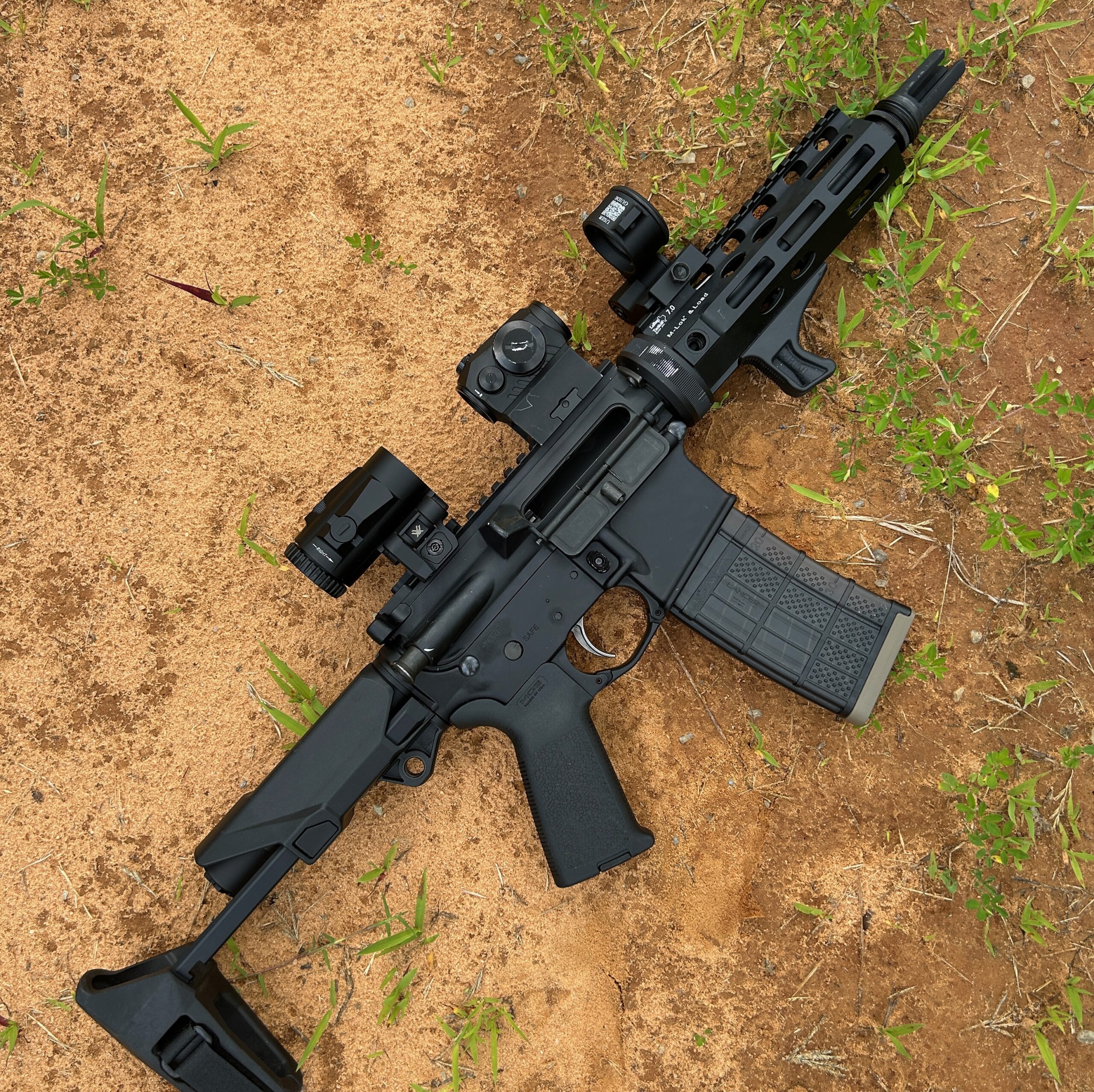
The TARAC mounts to a standard Picatinny rail. The version Zero Theory tested attached with a typical cross-bolt clamp mount. Their website, however, pictures a QD attachment which is probably standard issue as of this writing. They may still produce both versions, but the QD is probably the most popular. One thing worth noting is that it does not require precise alignment with the optic. As long as you can see through it, it functions. It is a simple, analog device which clips in front of your optic. It is nothing more complicated than that. Minor positioning differences do not appear to affect performance the way they would with a magnified optic. That said, it is available in a number of different mounting heights between 1.4” and 2.35”. You should choose the one that matches most closely to your optic’s centerline.
Flip Mechanism
The flip mechanism is done very well. It is simple and intuitive. It requires no buttons or latches. It simply flips into place or out of place as needed. It is held in place with friction and TACOM did a great job getting the amount just right. Too little and it won’t stay put. Too much, and it becomes difficult to deploy. No complaints here.
One very nice feature of the flip design is how far the lens actually rotates. Unlike many magnifiers, it can rotate much farther than simply “out of the way”. It actually rotates all the way around until it gets stopped by the handguard. This allows it to tuck relatively close to the rifle when not in use which reduces bulk and snag potential. We’ve all used magnifiers which flip out of the way, but then uncomfortably hang out there in space. Running them on your rifle that way for any length of time sort of feels like leaving a kitchen cabinet door open while you’re cooking. It’s not technically a problem, but it feels wrong. The Alpha TARAC doesn’t have this issue. It tucks neatly out of the way. In reality, it’s not much slimmer overall than a normal flip-to-side, but it feels a lot better.
Purchase Configuration vs User Adjustment
The Alpha TARAC is very user-configurable but not user-adjustable. This is an important distinction. Purchasing one on their website requires the user to make a number of configuration selections so it is built precisely to the user’s intended use case. As such, it is extensively configurable when you purchase it. Once it is built, though, it is what it is. Its beautiful simplicity necessarily limits its adjustability. Simply put, it is not adjustable at all. You order it how you want it and that is how it comes.
When ordering, the buyer selects:
- Firing Solution (MPBR, Speeddrop, etc)
- Rifle Zero
- Barrel Length
- Centerline
- Target Size
- Calculated Range
All of this together is used to determine the appropriate Prism Offset. For example, we tested both a 1.75 MRAD and a 2.18 MRAD version.
Hands-On Testing
For our purposes, we wanted to conduct practical testing. We had no interest in a laboratory evaluation. We wanted to know whether the Alpha TARAC worked in the same way an actual user would employ it. The central question was:
Can this device extend practical point-blank range without requiring the shooter to alter his aiming technique?
To do that, we did exactly what you would expect. Starting at a certain distance we engaged a given target without the Alpha TARAC in place, always holding center-mass, and recording the impact. Then we moved farther away from the target, reengaged, and recorded the impact again. We continued this process until we began missing low.
After that, we reset everything back to the original starting position and repeated the exact same process, except this time with the Alpha TARAC in place. In theory, with the Alpha TARAC in place we would be able to move further back from the target before we began missing low. In this way we were able to see if the device extended our MPBR and if so, how far back we could actually go.
The first iteration of the practical test used a steel target measuring approximately eighteen inches wide and twenty-four inches tall. In other words, roughly the size of a human torso. We used a laser rangefinder to measure distance, began at approximately 200 yards, and moved backwards incrementally until around 500 yards.
Again, the key factor here was to hold the center of the target at each firing position, no matter how far back we were. No holdovers or dialing were used. Absolutely no changes to point of aim were allowed. The entire purpose of the Alpha TARAC is to eliminate those adjustments. Changing the point of aim during testing would invalidate the concept being tested.
Test Rifle 1 – 16” 5.56 NATO AR-15
The first rifle tested was a 16” AR-15 equipped with a 1-6x riflescope, firing 62-grain Pinnacle Precision FMJ ammunition zeroed at 100 yards, and using the 1.75 MRAD Alpha TARAC. Density Altitude was 1575. Results were recorded as follows:
| Without Alpha TARAC | With Alpha TARAC | |
|
200 yards |
hit |
hit |
|
250 yards |
hit | hit |
|
300 yards |
hit | hit |
|
350 yards |
hit | hit |
|
400 yards |
miss | hit |
| 450 yards | miss |
hit |
| 475 yards | miss |
miss |
| 500 yards | miss |
miss |
| 540 yards | miss |
miss |
This was the simplest and most straightforward test platform. The purpose was to determine whether a standard AR-15 could benefit from the concept. As you can see from the chart, the Alpha TARAC did extend the MPBR of this setup from approximately 350 yards out to 450 yards. That is a difference of 100 additional yards.
Test Rifle 2 – 11.5” 5.56 NATO AR-15
The second rifle tested was an 11.5” AR-15 equipped with a 1-6x riflescope, firing 62-grain Pinnacle Precision FMJ ammunition zeroed at 100 yards, and using the 1.75 MRAD Alpha TARAC. Density Altitude was 1575. Results were recorded as follows:
|
Without Alpha TARAC |
With Alpha TARAC |
|
|
200 yards |
hit | hit |
| 250 yards | hit |
hit |
|
300 yards |
miss | hit |
| 350 yards | miss |
hit |
|
400 yards |
miss |
hit |
|
450 yards |
miss | miss |
| 475 yards | miss |
miss |
|
500 yards |
miss |
miss |
The second rifle setup was essentially identical to the first, except with a shorter 11.5” barrel. The purpose of this was to test the device with a popular short barrel configuration in order to compare the results with the standard 16” barrel setup. Here again, the Alpha TARAC did extend the MPBR, this time by 150 yards. Without the Alpha TARAC the 11.5” was only getting hits out to 250 yards, but with it in place was able to get hits all the way out to 400 yards.
Test Rifle 3 – 8.5″ 300 Blackout AR-15
The third rifle was tested in a similar manner, but with a slightly different configuration. For starters, this rifle was an 8.5” 300 Blackout. For this setup, TACOM HQ recommended the 2.18 MRAD version. Also, because we were running Blackout, it seemed only fitting to test it with both supersonic and subsonic ammo. The rifle was zeroed on the subsonic ammo at 25 yards. The supersonic ammo was observed to print approximately 2-3” high at this distance. Note – for this test we used a steel silhouette target approximately 18” wide and 30” tall. While this target was approximately 6” taller than the previous, most or all of the additional 6” was the silhouette’s head. In other words, the main target was functionally the exact same size. Results were recorded as follows:
Supersonic: Ammo Incorporated 110 gr V-Max
|
Without Alpha TARAC |
With Alpha TARAC |
|
|
100 yards |
hit | miss (high) |
| 125 yards | hit |
miss (high) |
|
150 yards |
hit |
miss (high) |
|
200 yards |
hit |
miss (high) |
Subsonic: Magtech 200 gr FMJ
|
Without Alpha TARAC |
With Alpha TARAC |
|
|
100 yards |
hit |
hit |
|
125 yards |
hit |
hit |
|
150 yards |
miss (low) |
hit |
|
200 yards |
miss (very low) |
miss (low) |
The Blackout results were pretty interesting. An 8.5” 300 Blackout is a much different rifle than a 16” 5.56. The Alpha TARAC had the same general effect on the round’s trajectory as expected, but to a much less useful effect. The result with supersonic ammo was predictably undesirable. Given the rifle was zeroed at such a close range, and on subsonic ammo, it was already shooting high with supers. Once you engage the Alpha TARAC, you’re missing the target on every shot. You’re shooting right over its head.
With subsonic ammunition, the short zero distance was mitigated and you began to see a result more similar to the 5.56 results. That is, the MPBR was extended, even if it was a much shorter distance. Without the Alpha TARAC the subsonic ammo began missing (low) beyond 125 yards, but once the Alpha TARAC was engaged that MPBR was extended by at least 25 yards.
Did It Work?
Yes. The Alpha TARAC worked exactly the way it was expected. The effect was obvious. The point of impact shifted whenever it was engaged and the usable MPBR was extended in three out of the four configurations tested. The only exception being the supersonic 300 Blackout, in which the trajectory was altered in the same fashion, but within the tested (read: most likely to be used) distances was rendered useless. This is not a fault of the device itself, but a simple and predictable result of using supersonic ammunition on a gun zeroed at very close range on subsonic ammunition. What else do you expect?
So yes, the practical point-blank range of the rifles was extended in a useful way. And you would be forgiven if your takeaway from these tests was something like “seems useful for 5.56, but not as much for 300 Blackout”. But hold on there a minute. These results actually implied a very interesting use case for 300 Blackout which may not be immediately obvious. We will spell that out below in the Applications & Use Cases section. In fact, it might be the most compelling potential use of this device of all.
Verification Testing
Although we were most interested in the practical shooting tests, it seemed prudent to conduct a basic field test to verify the actual point-of-impact shift imparted by the Alpha TARAC as measured through the optic, if for nothing else than to verify the accuracy of the advertised parallax shift. For this reason, we conducted a simple bench test using a tripod-mounted rifle and a ruler positioned 45 yards apart. Here, the unit tested was advertised as providing a 2.18 MRAD offset.
Essentially, all we did was aim our rifle at a ruler and write down where the crosshair landed before and after placing the Alpha TARAC into position. In this case the measured point-of-impact displacement was 3⅝ inches at 45 yards, which calculates to approximately 2.24 mils. This is 0.06 MRAD greater than the advertised value of 2.18 MRAD.
Given the limitations of the test method—including ruler measurement, target placement, and the realities of a field test rather than a controlled laboratory evaluation—I consider a discrepancy of roughly one-twentieth of a mil to be well within the expected margin of error. Based on this testing, I found the advertised 2.18 MRAD offset to be accurate for all practical purposes.
For context, a 0.06 mil difference equates to approximately 0.1 inches at 45 yards, making it difficult to completely eliminate measurement error when using field-expedient methods. The observed result was close enough to the published specification that I have no reason to question TACOM HQ’s stated offset value.
Usability Factors
The Alpha TARAC is extremely easy to use. It is basically a toggle switch. On or off. In or out. That’s it. It is extremely light, and works best when placed directly in front of your optic, which is near the balance point of the rifle anyway. Weight is a non-factor. Like any flip-to-side device, it technically creates some additional bulk. In practice these concerns are often exaggerated or at least sometimes overstated. Yes, it does create an additional “snag hazard” but it is nothing untenable. Its most significant downside may simply be that it is one more thing attached to a rifle that is likely already covered in gear. Of course, that is a very subjective assessment and has little to do with the Alpha TARAC itself. Objectively, it tucks away tighter than most magnifiers (which mount and stow in a similar fashion)
One unexpected consideration is actually remembering when you have it engaged. Externally it is obvious. The device is either flipped into place or not. But while looking through the optic, it is not obvious. Remember, the view through the optic is not changed. It is not like looking through a magnifier. You may not be able to tell you are looking through it at all. Because the image appears essentially unchanged, it is entirely possible to forget that it is engaged. For that reason, once or twice we actually fired it in the wrong configuration and had to come off the scope to see what was wrong. Again, this is not a flaw. It is simply a consequence of how the device works.
Alternatives & Paradox
The Alpha TARAC is a unique product. As such, it does not compete head-to-head with much else in the way a typical riflescope does. If you want to buy a 10x DMR scope, you have dozens of options from which to choose. The Alpha TARAC is different because it is not really competing against another product. It is competing against knowledge.
Simply put, the Alpha TARAC shifts the point of impact by a fixed, repeatable amount. A knowledgeable shooter can accomplish the same thing by:
- Holding elevation
- Dialing elevation
- Using a BDC
- Using a MIL reticle
- Using an MOA reticle
The Alpha TARAC does not outperform those solutions. It simply removes the need to consciously apply them. That is the important distinction. The Alpha TARAC imparts this POI shift unconsciously.
This creates an interesting paradox and perhaps the most interesting criticism of the product, which is, the people who understand holdovers and ballistic corrections do not really need the TARAC. On the other hand, the people who would benefit most from simplified shooting likely do not understand the product enough to know how to use it.
In other words: The people who need it least understand it best and the people who need it most understand it least. That does not make it a bad product, but it does make it specialized. The biggest mistake a buyer can make is assuming that specialized military equipment is automatically useful to them. Specialized does not mean superior. Specialized means specialized. The Alpha TARAC has a narrow mission. It performs that mission well. But it remains a narrow mission.
Applications & Use Cases
If there is a single application where the Alpha TARAC makes the most sense, it is on a military infantry rifle. The problem set aligns almost perfectly with the device’s strengths: human-sized targets at intermediate distances, a minimal training burden, and a need for simple, repeatable instructions that can be applied under stress. The concept is straightforward: hold center on the target. If the target is farther away, flip the TARAC into place and continue holding center. The shooter does not need to remember complex holdovers, dial adjustments, or multiple aiming references.
In some respects, this is simply a modernized version of a very old idea. The original M16 iron sights employed a similar concept, using one aperture for closer engagements and a second for longer distances. The shooter selected the appropriate sight configuration based on the expected range and then continued aiming normally. The Alpha TARAC follows the same philosophy but adapts it to modern optics, extending practical engagement distance through a fixed and repeatable POI shift while preserving a simple, intuitive aiming process.
The original hunting example remains compelling. A hunter who values simplicity could use the Alpha TARAC to extend practical point-blank range without memorizing additional holds or making adjustments in the field. Of course, the relatively small target areas associated with ethical hunting shots may limit the practicality of this approach, depending on the game and the distances involved. The guy at SHOT Show who first introduced me to the Alpha TARAC was absolutely convinced of its utility in this role, specifically on his 14.5” 6 ARC. Was he overselling it? Maybe. Then again, elk are large animals and 6 ARC is fast and flat. As always, your mileage may vary.
Now we come to what may be the most interesting use case of all: 300 Blackout ammo switching. You’ll recall our 300 Blackout test rifle was zeroed on heavy subsonic ammo at 25 yards, which resulted in the lighter and faster supersonic ammo printing about 2-3” higher at that distance. Instead of zeroing on subsonic ammo, what if the shooter zeroed on the supersonics? The subsonics would then print 2-3” low. Do you see where we’re going? The beauty of the 300 Blackout SBR is the ability to switch between supers and subs with nothing more than a mag change. Now, a shooter can measure the downward POI shift of their subsonic ammo then match it to an Alpha TARAC of a similar offset. This allows the shooter to run their supersonic ammo as normal and then when they switch to subsonic ammo just flip the Alpha TARAC into place and BOOM…they are back on zero. The shooter NEVER needs to remember holdoffs. All they need to remember is to flip the Alpha TARAC in place whenever they insert a subsonic mag. That is it. Aim center mass all the time. No zero shift to consider, no offset to remember. Just point and click. Beautiful. This seems a potentially elegant solution right in line with the practical novelty of a 300 Blackout SBR that was built with split personalities. One disclaimer, we haven’t thoroughly tested this idea. It’s just a concept. But it does seem to have real potential. Additional testing is warranted.
Lastly, there is one more potential use case we can imagine, although it sits well outside the box. In fact, it is really just a thought experiment that came up during testing. What if TACOM HQ built a reverse Alpha TARAC—one that shifted point of impact downward instead of upward?
One of our testers recalled his time on a federal law enforcement SWAT team, where he carried an 11.5” AR equipped with an EOTech holographic sight. Like all reflex sights, it required accounting for height-over-bore at close distances. Because SWAT operations frequently occur inside homes, close-range engagements were common enough that the team adopted a simple rule: anytime we are inside the house, aim using the bottom tick of the reticle. This referred to the small hash mark at the six o’clock position of EOTech’s well-known circle-dot reticle.
A reverse TARAC could theoretically accomplish the same thing by mechanically compensating for height-over-bore at close range. Instead of remembering to “hold the bottom tick,” the shooter would simply flip the device into place.
To be clear, such a product does not exist today—and perhaps for good reason. It has the feel of a solution in search of a problem. Still, the concept serves to illustrate how flexible the underlying optical principle behind the Alpha TARAC might be.
Who Should Consider the Alpha TARAC?
If you already appreciate the value of maximum point-blank range shooting, the Alpha TARAC is a fascinating piece of equipment and one that warrants serious consideration. Shooters who routinely think about trajectory simplification, unknown-distance engagements, and ways to extend practical point-blank range will immediately understand what this device brings to the table. Conversely, if concepts like MPBR and trajectory management are not already part of your shooting vocabulary, the Alpha TARAC is probably not intended for you.
Whether it is extending the practical reach of an infantry rifle while preserving a simple “hold center” approach, or instantly shifting between supersonic and subsonic trajectories on a 300 Blackout, the Alpha TARAC’s greatest appeal lies in its simplicity. Rather than requiring the shooter to memorize additional holds or manipulate turrets, it offers a straightforward, repeatable way to change the rifle’s trajectory with the flip of a lever.
Final Thoughts
The Alpha TARAC worked. That is the simplest conclusion. The more meaningful conclusion, however, is that this review is ultimately less about a product and more about a philosophy of shooting. The Alpha TARAC forces shooters to think about maximum point-blank range, trajectory management, and whether there is value in simplifying ballistic problems rather than solving them with additional holds, reticles, or turret adjustments. For shooters who already appreciate those concepts, the Alpha TARAC is a genuinely interesting and capable tool. For shooters who do not, it will likely seem unnecessary. Both reactions are entirely reasonable. In the end, the real question is not whether the Alpha TARAC works. The real question is whether you value the problem it was designed to solve.